We spoke with Kyla Kupferstein Torres, executive editor of Callaloo, in our latest member spotlight.
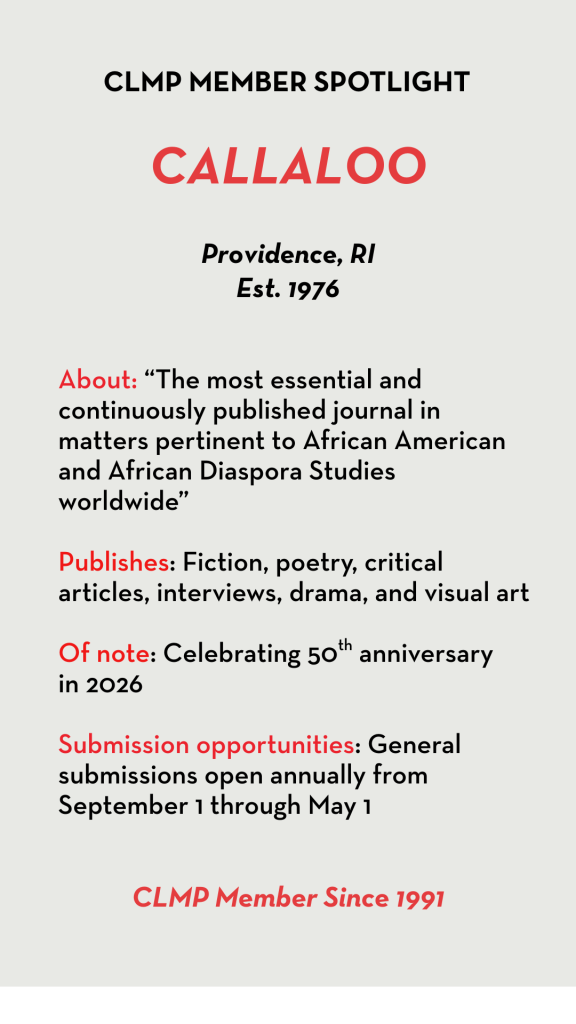 What is the history behind Callaloo? When was it founded and what is its mission?
Callaloo was founded in 1976 by Dr. Charles H. Rowell at Southern University in Baton Rouge, Louisiana. The journal began as a vital space for Black Southern writers who had long been excluded from the world of publishing and literary criticism. It was of paramount importance to Dr. Rowell to open these worlds to writers who had been dismissed as backward and uneducated, denigrated in all the ways that descendants of formerly enslaved people had been (and continue to be). As Callaloo gained attention and engagement from colleagues, Dr. Rowell’s vision expanded to become diasporic, and the journal began to include work by and about the breadth of the African Diaspora. It quickly became an international project, and soon, it was regarded as the destination for Black writers. Dr. Rowell maintained a very high standard for the work he presented, and the roster of Callaloo contributors attests to this.
That original mission is still what we’re following today: to provide a consistent space for the work of Black writers, academics, and visual artists, a place where their work is taken seriously, on its own terms, regardless as to whether Black people and their concerns are “in vogue” with the larger society.
Callaloo celebrates its fiftieth anniversary in 2026. What are your hopes and goals for the magazine’s future?
There is so much pressure these days for every publishing endeavor to become some sort of media empire. My greatest goal is to provide consistency and excellence for our journal’s writers, scholars, and readers, and to focus on finding excellent work that can surprise or illuminate our lives.
In terms of content, I am hoping that we can grow our focus on creative nonfiction. I also hope to feature more visual art in each issue; Callaloo Art, devoted to African Diaspora visual art and culture, will definitely be making a comeback in the next year or so with some exciting events.
In March 2025 we announced that Callaloo would be partnering with Brown University and its Department of Literary Arts, and this editorial partnership has been an incredible boost, providing us with a new stability and allowing us to really focus on the work that makes Callaloo great. We’re very excited about all that this partnership brings to us, particularly in terms of the creative and scholarly community we’re building in Providence and beyond.
Dr. Charles H. Rowell was recently awarded both the Distinguished Editor Award from the Council of Editors of Learned Journals (CELJ) and the PEN/Nora Magid Award for Editing. Can you tell us more about Callaloo’s editorial process and approach?
 Callaloo has long been known for its high standards and selectivity. As we say on our submission guidelines, we expect to receive final drafts, not works-in-progress, for review and acceptance. That said, when we find work that’s not quite there but has serious promise, we will encourage writers with specific notes and feedback. As Callaloo’s executive editor, as well as a longtime educator, I find myself wanting to reach out and nurture writers who have something special, to help them develop and move toward publication. But we’re a small team—only two of us are full time!—so we have to be quite discerning, balancing our excitement about a piece that needs development against our capacity to give a writer the support and guidance she deserves. There’s also the balancing act of genres. Callaloo has long been a destination for poets, and we receive tons of poetry submissions. I want to ensure that we’re publishing a balance of types of writing, different forms and styles, as well as a balance of prose and poetry, and scholarship.
Another tension in our editorial work stems from the fact that we are a Black/African Diaspora publication. It’s not enough to submit work to Callaloo that’s “about” Black people, or Blackness; we’re looking for insightful, skilled writers and artists who speak from a specific point of view and allow us to see the experience of being Black in the world in a new way. We want to identify the writers who are bringing artistry and craft that can further our understanding of ourselves as human beings, regardless of what race our readers are. We are, and will always be, a Black publication, but we are also in direct conversation with the wider world of literature and criticism. We have the luxury of hearing (and reading) a Black voice with clarity and identification, but must also be the stewards of the excellence that Callaloo is known for.
Callaloo showcases both creative writing and critical studies of the arts and humanities. What are some of the rewards and challenges of publishing both creative and scholarly work?
 The review processes for these kinds of writing are very different. Fiction, poetry, and creative nonfiction submissions are all reviewed by genre-specific teams of reviewers and editors, following a model similar to that of other literary journals. Our process for scholarly writing, on the other hand, is a bit more specific—we have to follow academic standards for peer review, and we hand-select academics to review submissions based on their areas of expertise. The turnaround times for reviewing and editing each type of work vary, and communicating that to authors can be challenging. Everyone on our team is a writer in their own right, so we all know how anxiety-provoking it can be to wait for a response to a submission. The reward, as always, is continuing to nurture a space where Black readers and writers can expect rigorous work across genres.
Are there any indie bookstores or libraries that you think do a particularly good job featuring print literary magazines (or titles from indie publishers)? If so, what do they do?
I divide my time between New York and the Bay Area, both of which have a number of great indie bookstores, many with a dedicated magazine/journal section and really well-curated “Staff Picks.” In the Bay I like East Bay Booksellers, Pegasus Books, Spectator Books, and Green Apple Books. In New York, Unnameable Books, McNally Jackson, and Greenlight Books, and of course, The Strand. Casa Magazines in New York is another favorite—the sheer number and breadth of print titles they have is always a treat.
How can readers order or subscribe to Callaloo?
We’re not on newsstands in most places, so folks can order and subscribe to Callaloo via the Johns Hopkins University Press website. Our website will also redirect you there. We hope to start selling “vintage” Callaloo issues on our website in the near future!
How can interested writers submit their work to Callaloo?
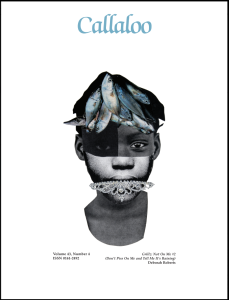 You can find our general submission guidelines, as well as open calls for specific issues, on our website. Our general submissions in all genres are open until May 1, after which we close for the summer before reopening in September.
Currently, we are seeking submissions for a special 50th anniversary issue; for our golden anniversary we’re going back to our roots with an issue dedicated to writing and art from (and about) Black life in the US South. It will be guest-edited by Tyree Day, one of our co-editors for poetry. The submission deadline is February 14, 2026.
In that issue, and in general, Callaloo is hoping to publish more creative nonfiction. Are you the next Hanif Abdurraquib, Nikole Hannah-Jones, Claudia Rankine, James Alan McPherson, Emily Bernard, Ta-Nehisi Coates, Jesmyn Ward, Ross Gay, or Zadie Smith? Do you have something fresh, specific, and insightful to say about the world we’re living in or the things you’ve experienced?