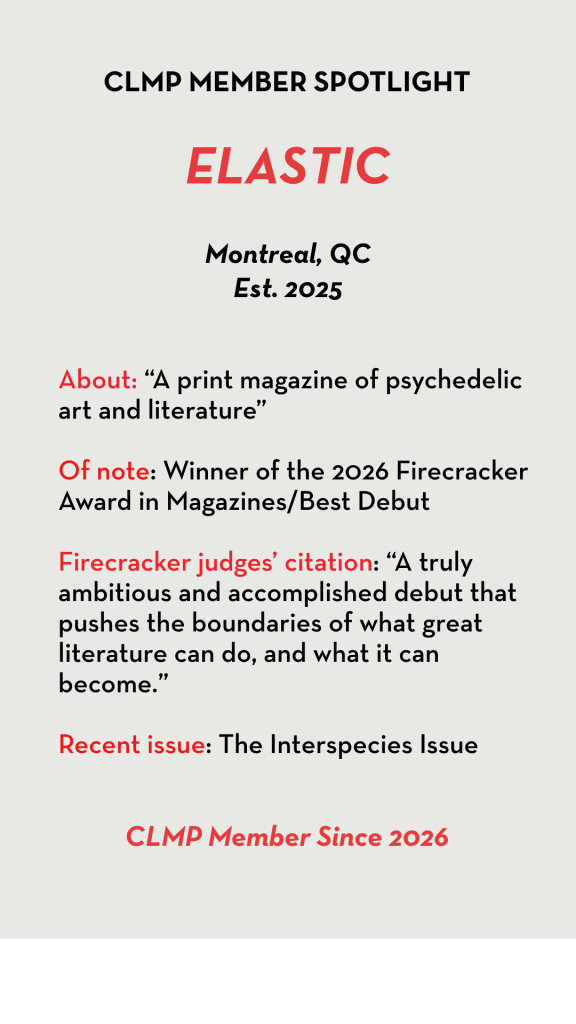
We spoke with Hillary Brenhouse, editor in chief and publisher of Elastic, winner of the 2026 Firecracker Award in Magazines/Best Debut, in our latest member spotlight.
 What is the history behind Elastic? When was it founded and what is its mission?
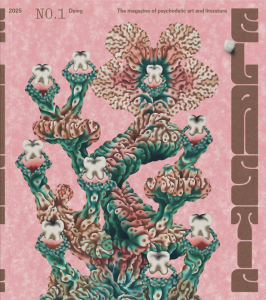
The first issue of Elastic was published in 2025, but by that time I had been envisioning the magazine for several years. I’d become disillusioned with the narrow, cartoonish version of psychedelic art that dominates the popular imagination (Day-Glo mandalas, contorted mushrooms, Rick and Morty ambling through spacescapes). At the same time, as a literary editor and a reader, I found myself increasingly drawn to time-bending, genre-bending, form-breaking writing that seemed, to me, to much more readily evoke the psychedelic experience.
Then I came across a feature by the brilliant cultural critic Emily Lordi in T: The New York Times Style Magazine about the underrecognized Black creative leaders of the first psychedelic movement, and some of the reasons why the category now conjures little more than “images of young white people dancing lethargically to the Grateful Dead.” I came to understand that the first psychedelic era, which crystallized in the mid-sixties, was a period of radical (and radically diverse) artistic and literary innovation that’s been flattened or outright dismissed by historians and arts institutions.
And so Elastic was born as a testament to the vitality and breadth, the wild expansiveness, of psychedelic art and writing. It was conceived as a space for artistic freedom, innovation, and experimentation. What we mean by “psychedelic art” is not any single aesthetic or approach, but work that resists containment and expands to meet the overwhelming possibilities of our lives. This magazine isn’t about psychedelic substances or nostalgia for the past. It’s a home for pieces that resist imagined boundaries: between waking and dreaming life, between fiction and nonfiction, between self and other, and the constraints imposed by linear time and colonial narrative structures. It also aims to pay tribute to an overlooked literary and artistic archive, much of which was authored by artists and thinkers of color.
Elastic is an artist-led publication in the sense that our contributors determine the shape of these pages. And the things they send in are invariably weirder and more formally ambitious than anything I myself could imagine or impose; they respond to the distorted world around us by rendering it newly strange, capturing how sublime and absurd and tragic it is to be alive right now. The idea is to foster a conversation about the shape of psychedelia—what it was, is, and might be—by welcoming in work that exceeds the slim creative containers that are constantly being pressed upon us.
Elastic released its second issue in May. What can readers find in this issue, and what can they look forward to in your next issue?
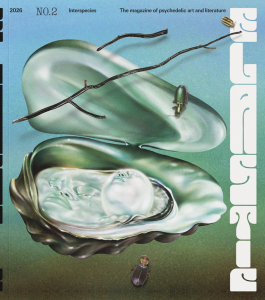 Elastic’s second volume is the Interspecies Issue. It spans 176 pages and features 52 contributing writers and visual artists. By interspecies, these writers and artists mean exchanges between humans, plants, animals, fungi. They also mean interactions with the landscape, the elements, bacteria and parasites, coral reefs, ghosts. They mean that we are being invaded—by floods and fires and machines—and that we are invaders, wrecking each other and wrecking ourselves. Some of our contributors are interested in the porousness of the self, ecological grief and entanglements, and the shape of relationships that occur outside the limits of language. Others adopt a nonhuman perspective to portray guilt, alienation, marginality, metamorphosis, what it’s like to be absolutely misunderstood. I tend to think of the issue as oscillating between the enormity of interconnection and the enormity of solitude.
CAConrad communes with the sunrise, inhabiting that moment of first light “when all nouns seem to dissolve into one form.” Daisy Hildyard fractures syntax to convey cattle communicating via the body, where the body is the text. Women turn into birds (and sharks, mountains, microwaves). Boundless dreams unfold in a dark, whispering forest and the “fluorescent tomb” of a Rite Aid. The end is always near, but is never quite an end. As Vivian Hu writes, “Nothing was dying, it was being reorganized.” The issue also features extraordinary writing by Kelly Link, Fernando A. Flores, Lara Mimosa Montes, Patricia Lockwood, Dorothea Lasky, Bhanu Kapil, Elissa Washuta, ’Pemi Aguda, Avigayl Sharp, Gina Chung, Gabrielle Bates, Brandon Shimoda, and many others, alongside some of the most layered, lush, and inventive visual art I’ve ever seen.
We’ve just begun to assemble our third issue, which will be unthemed. (Or we’ll choose the theme once we’ve seen how the pieces within speak to each other, which feels like a more appropriately psychedelic process!) It will launch in spring 2027, with the generous support of Harvard University, and I’m hoping that it will be accompanied by a constellation of creative programming. As always, the work within will break form in all kinds of unimaginable ways in order to get at our twisted present and states of being that are impossible to describe straightforwardly or linearly.
Elastic received CLMP’s 2026 Firecracker Award in Magazines/Best Debut; the judges’ citation notes, “Elastic takes a subject we might think we know and understand—psychedelia—and expands it beyond an homage to a bygone era and into an emphatic reimagining of radical creativity for our current times.” What does this recognition mean to you?
 It means the whole world to us to be honored, alongside a cohort of new magazines we admire, by a community that has sustained independent publishing for so many decades. And it is an exceptional gift to be seen in the way we see ourselves: as a site for radical creativity that speaks to our current moment.
Elastic began as a somewhat improbable proposition: a hefty, independently published, nonprofit, print-only publication stewarded by a miniscule team and invested in writing that resists conventional narrative shapes, that takes risks, that grants itself the right to be elusive and disorienting. That the project has been distinguished by one of our most vital literary organizations right out of the gate is hugely affirming and encouraging. Above all, it’s a tribute to our contributors, who are constantly expanding our sense of what a literary magazine can be.
Every editorial and production decision we make is meant to allow the work in these issues to assume the shape it wants to take. We don’t classify the pieces we publish as “short stories” or “essays” or “poems.” The work is not even confined by the limits of the page; our incredible creative director, Chloe Scheffe, designs Elastic such that language and images are permitted to escape their frames, flow into each other, transmogrify, repeat. The magazine is itself an attempt to create the conditions under which form-breaking, mind-expanding art and writing can flourish. We’re so grateful to CLMP for recognizing that intention.
Are there any indie bookstores (or libraries) that you think do a particularly good job featuring print literary magazines, as well as titles from indie publishers? If so, what do they do?
 Elastic doesn’t have a distributor; the people who make this magazine distribute this magazine. As a consequence, we’ve had the rare privilege of developing relationships with every single bookstore that carries our issues; we chose them deliberately and we could not do this without them. Our stockists are wonderfully and generously invested in print literary magazines, and are willing to take chances on unfamiliar publications by tiny presses when they feel moved by a project. I’m thinking, in particular, of places like Rough Draft Bar & Books in Kingston, New York; East Bay Booksellers in Oakland, California; Atomic Books in Baltimore, Maryland; and Lost City Books in Washington, DC. They’ll do things like showcase independent magazines at literary and art book fairs. They’ll arrange, on their own, to have a local writer who’s contributed to your magazine drop by their shop to read from it. They’ll put your publication in conversation with the books it speaks to through programming and thoughtful table and window displays. They treat lit mags not like ephemera, but as foundational to the literary ecosystem.
I also want to shout out indie shops that are focused specifically on magazines—for instance, The City Reader in Portland, Periodicals in Detroit, and Casa in New York City. Small magazine publishing is not just alive, it is thriving, in part because dedicated mag stores present these publications as collectible, enduring cultural objects.
How can bookstores or libraries, as well as individual readers, order or subscribe to Elastic?
Individual readers can order Elastic, which is now available worldwide, from our website. Bookstores and libraries can email [email protected] to inquire about carrying the magazine. As mentioned above, we love our stockists, and we are always looking for more stores that feel aligned in approach with this project.
How can interested writers submit their work to your literary magazine?
Our current reading period opened on August 7, 2026, and ends on August 30, and submissions can be sent here! Interested writers should sign up to our newsletter or follow us on Instagram to find out when and how to submit in the future as well. We’re looking for work that is weird and dreamy, that messes with time and perspective, that multiplies and distorts the possibilities of narrative, that finds sublimity and absurdity in the everyday, that magnifies the senses, that ruptures language, as a way of reflecting our mystifying, unhinged moment and the ineffability of the human condition.