We spoke with Heather Gluck, managing editor of Epiphany, in our latest Member Spotlight.
 What is the history behind Epiphany? When was it founded and what is its mission?
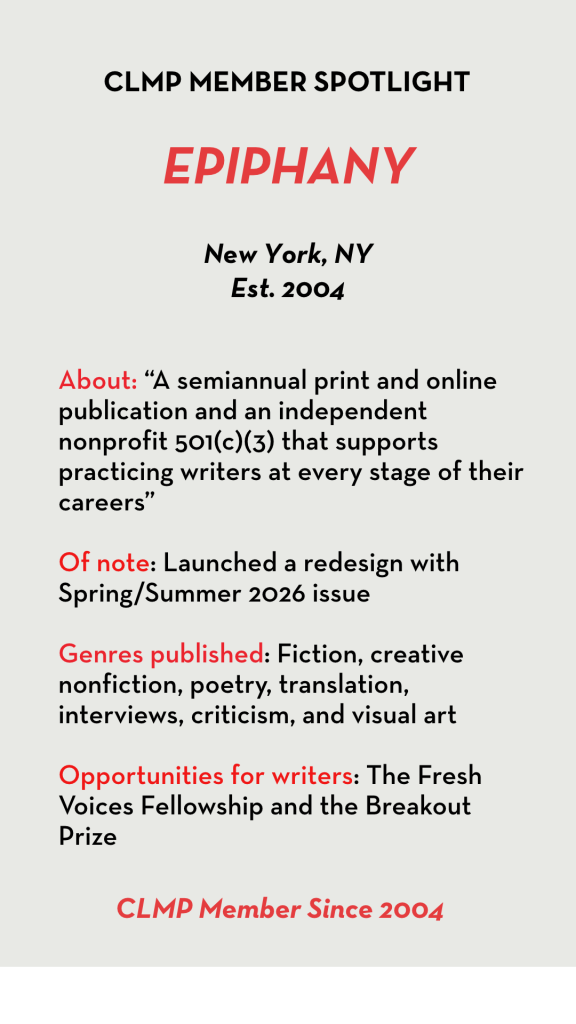
Epiphany was founded in 2002 by Willard Cook, a writer and educator who was then teaching in NYU’s undergraduate writing program. The magazine began as a project of the university but shortly transitioned to an independent 501(c)(3) nonprofit, which it still is today. The name Epiphany was inspired by James Joyce’s use of the word, which he borrowed from its Christian origins and redefined as a secular moment of discovery in literature, where suddenly “the soul of the commonest object … seems to us radiant.” The semicolon of our logo was envisioned in that vein as a pause, a moment to reflect without ceasing, an element that is both a part of language and outside of it.
Epiphany is a semiannual print and online literary magazine and nonprofit 501(c)(3) that supports writers at all career stages. We publish fiction, creative nonfiction, poetry, translation, interviews, criticism, and visual art. With our Breakout Prize and Fresh Voices Fellowship, we platform emerging writers and writers of color who exist outside the literary establishment. Our mission is to champion innovative literature, nurture exciting new voices, sustain the writer-editor relationship, and promote a healthy literary ecosystem. We are committed to editorial integrity and collaborate closely with authors in a transparent, non-hierarchical, dialogue-driven editorial process.
Our goal is to discover writing that has fire and nerve—pieces that engender discovery within ourselves and the larger world—and work closely with their writers, both emerging and established, to develop them into something robust and remarkable.
You launched a redesign with your Spring/Summer 2026 issue. Can you tell us about this redesign, and the issue?
 Our goal with the redesign was to create a look that felt true to the experience of writing, and true to the work we publish—a bit whimsical, a bit of an archive, a bit messy. Handwritten design details and typewriter fonts exist throughout the book and website as an homage to physical media and to the hands-on, analog nature of writing. We hoped the new design would also reflect the highly involved relationships our editors have with our writers. Most of the work we publish at Epiphany undergoes multiple rounds of developmental edits, and it’s a process we and our writers both cherish. Under each piece on our website, we have a comments section where readers often share their thoughts. All around, we hope this design evokes a feeling of collaboration and interconnectedness, that the magazine is a living thing built by readers, writers, and editors.
The alphabetical index on our website, which can be clicked to bring you to a variety of serious and irreverent tags (under H find Hamlet, Happy Endings, Haunted Houses, High School, Holocaust, Homelessness, Hot Dogs), was an inspired idea by our designer Lucy Andersen to bring our long print tradition of the unconventional back cover index to the website. Not only do we find these creative indices a fun way to explore the work in our magazine and on our site, but we also enjoy drawing unexpected connections between pieces, noting what themes and subjects recur, and what ideas seem to move our contributors and our editors. In life, the inane and the tragic coexist, and we find it’s the same in Epiphany.
What can readers look forward to in your next issue?
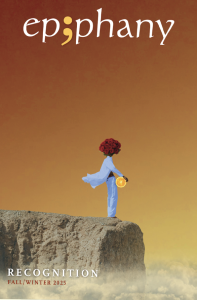
Readers can look forward to pieces that tackle subjects like immigration, addiction, and sex trafficking; that find humor in grief, and love in unlikely places. The stories in this issue will transport them to the forests of Belarus, to war-ravaged Gaza, rural northern Mexico, a grieving India and mid-COVID China, and the drug-addled skate parks of Southern California. They can expect to find a selection of poems chosen by our guest editor Diana Khoi Nguyen, as well as writing by Anna Kovatcheva, Margaret Malone, Stephen O’Connor, and Robert Lopez.
Are there any indie bookstores (or libraries) that you think do a particularly good job featuring print literary magazines, as well as titles from indie publishers? If so, what do they do?
We love Black Spring Books, Liz’s Book Bar, and Unnameable Books, not just for their selection but also regularly hosting readings, talks, book signings, and other in-person events for indie authors and readers!
How can bookstores or libraries, as well as individual readers, order or subscribe to Epiphany?
Individual readers can buy a copy or subscribe to Epiphany via our website. Bookstores and libraries can email us at [email protected].
How can interested writers submit their work to Epiphany?
Writers can head to our Submittable to submit and to see our full timeline of submission windows. Through October 15, we are accepting submissions for our Fresh Voices Fellowship, which offers $2,000, a mentorship, and a seat on our editorial team to an early-career writer of color without an advanced writing degree. Submissions for this opportunity are free.
Our regular print submissions open November 1, and we are a paying market—$75 per poem in print, $175 per story or essay in print.