We spoke with Paul Jaskunas, the editor of Full Bleed, in our latest Member Spotlight.
 What is the history behind Full Bleed? When was it founded and what is its mission?
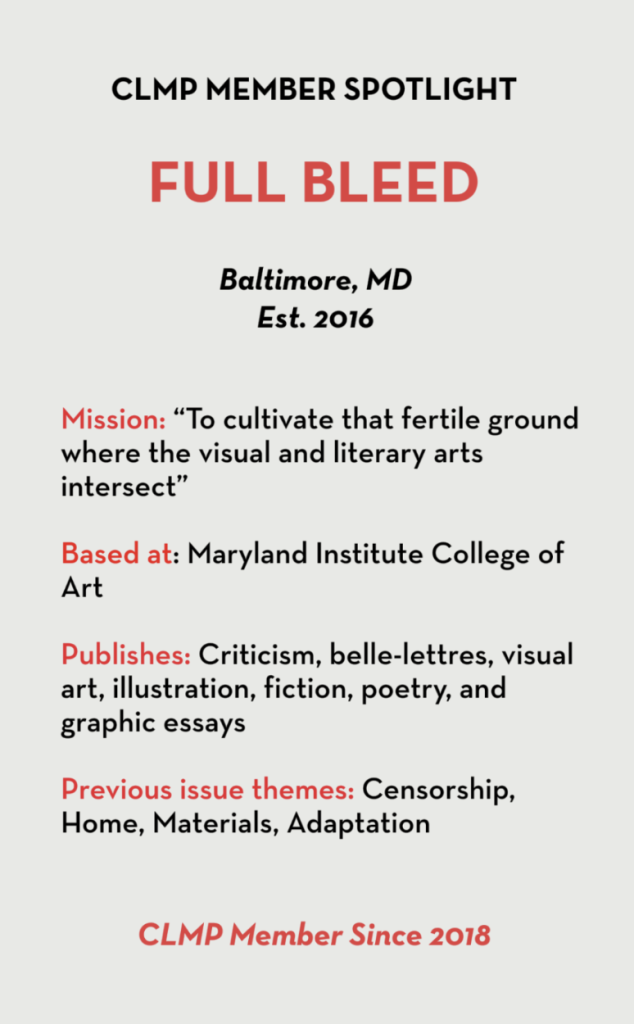
We started Full Bleed nearly a decade ago—the first call for submissions went public in the fall of 2016. We’re based in the liberal arts division at the Maryland Institute College of Art in Baltimore. So, we’ve always wanted to bring writers into conversation with visual artists, illustrators, and designers. We’re a forum for hybrids of word and image, ekphrastic writing, and smart essays and stories about contemporary art. We also publish poetry and prose that have nothing to do with visual art, but we usually pair that work with commissioned illustration, artwork, or interesting design elements. Our layouts are created by upper-level graphic design majors or grad students at MICA.
I’d say, too, that I’ve always wanted the journal to be generative of new work, new ideas, and possibilities. We like to showcase projects that we think could swing open a door in a reader’s imagination and lead to a further creation, breakthrough, or collaboration.
What are some of the rewards and challenges of featuring work that engages with or includes both written and visual art?
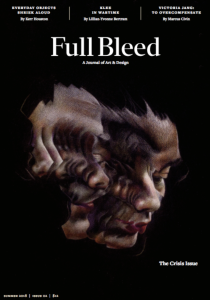
What pleases me most is when writers say they feel their work has been enriched by the journal’s art direction. We put a lot of thought into design and the images that accompany each feature. At times, it’s a bit like playing matchmaker. For our 2024 issue, we were considering an essay by Sarah Courteau about raising a young child in a changing climate. Previously, we’d looked at some paintings that Margaret Curits had sent us. One of my students realized that the two submissions would go together perfectly. She was right. Both Curtis and Couteau were delighted by the pairing, and a correspondence developed between them, I believe.
Other examples: in our second issue, Lillian-Yvonne Bertram sent us a graphic essay, “Klee in Wartime,” that used a variety of typefaces and formats. We handed it over to a talented young designer who did a marvelous job preparing Bertram’s piece for publication. And for our 2023 issue, we published an essay by DW McKinney and ran it with illustrations by Yifan Luo, a graduate student at MICA at the time. That piece went on to be a noted work in Best American Essays the following year.
Can you tell us about Publishing Culture?
Publishing Culture is an upper-level class that I’ve taught annually for the past nine years. For most of that time, I co-taught the course with a publication designer. One group of students would read, select, and edit submissions; another group would design, produce, and market the publication. It was very interdisciplinary, very integrative, but also very chaotic! Too much had to happen in too short a time, so we’ve changed the format a bit. This year, the students in Publishing Culture are involved in reading, fact-checking, and copy-editing submissions. They’re also producing a small zine that features creative writing by MICA students, which we don’t publish in Full Bleed to avoid conflicts of interest. The design work will all take place in a graphic design class during the spring semester.
What are some other literary journals, small presses, and organizations you admire that also explore the intersection between the literary and visual arts?
I always loved Cabinet—such a beautiful, well-written, and splendidly produced journal, which moved to an entirely digital format in 2023. Paper Monument was a fun little journal while it lasted. Bomb is still around, thankfully, and I like their mix of offerings. I’ve also been very impressed with the work of Stenen Press, which produces lovely books of literature translated visually as well as linguistically. I should also mention Spuyten Duyvil, which recently released a “memoir in artifact” by one of our contributors, Cris Mazza (It’s No Puzzle, which we published an excerpt from before it became a book). Last year, Spuyten Duyvil also released a short volume of my own ekphrastic poems responding to the work of Baltimore artist Warren Linn (Drawing Lessons).
Are there any indie bookstores or libraries that you think do a particularly good job featuring print literary magazines? If so, what do they do?
I’d like to give credit to Greedy Reads in Baltimore. (Full disclosure: they were a sponsor for our most recent issue.) They also host a fun little literary festival called The Lost Weekend that brings together Baltimore writers, journals, musicians, and artists. They have two stores in the city now and sometimes host events organized by local publishers.
How can readers order Full Bleed?
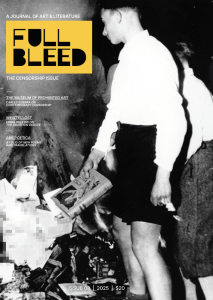
You can order our current print issue (on the theme of censorship) on our website; we’ve also made a digital edition available as a modestly priced PDF. Some of our back issues, those that haven’t sold out, are available for purchase as well.
How can interested writers submit their work?
We typically open for submissions for a few months in the fall, beginning in August or September. Sign up for our newsletter, and we’ll be sure to alert you when we open up again next fall.