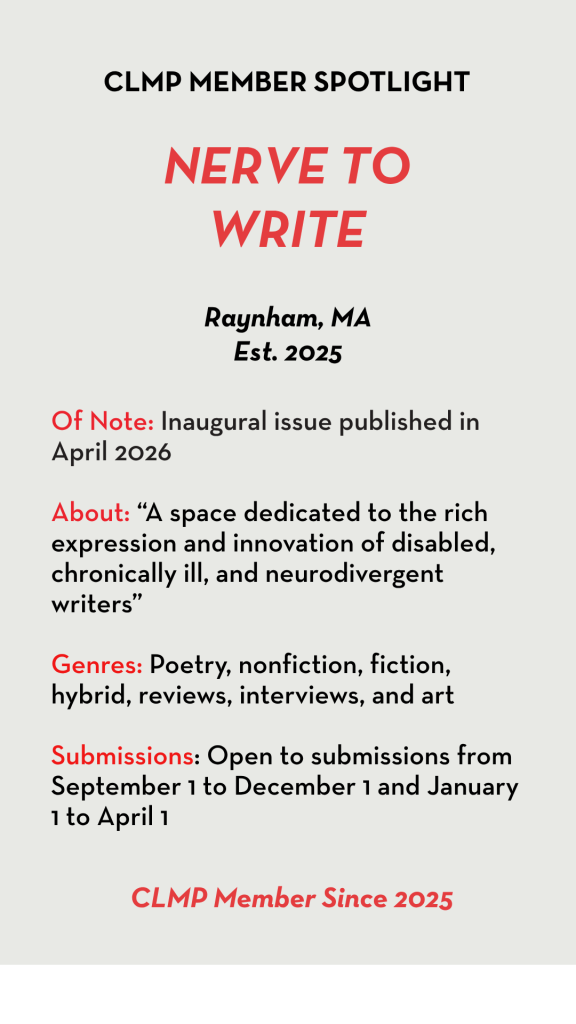
We spoke with Sarah Fawn Montgomery, editor in chief of Nerve to Write, in our latest member spotlight.
 What is the history behind Nerve to Write? When was it founded and what is its mission?
Nerve to Write was founded in September 2025 as an extension of a craft book I published with Sundress Publications in March 2025. Nerve: Unlearning Workshop Ableism to Develop Your Disabled Writing Practice interrogates power and privilege within the creative writing classroom, making space for disability, chronic illness, and neurodivergence, and it is one of the only craft texts that explores the dangers of the ableist writing workshop. I was overwhelmed by the support this book received from readers, many of whom had experienced ableism in the writing world and were looking for ways to build crip community. After connecting with so many readers about the importance of work centering disability, I decided to collaborate with a great team of editors and graduate students at Bridgewater State University to create a space dedicated to disabled, chronically ill, and neurodivergent creativity. We publish rolling author interviews and book reviews, and our first issue was released in spring of 2026!
Can you tell us more about the work Nerve to Write is doing to create a space for disabled, chronically ill, and neurodivergent writers?
 There are many magazines in the literary landscape, yet few actively center work by disabled, chronically ill, and neurodivergent writers. Those that do feature work about disability often do so from non-disabled perspectives, including abled family members talking about caregiving or healthcare workers who do not experience disability firsthand. Our mission is to create a space where literature and art are created by disabled people for disabled people, without the pressures and expectations to perform disability for abled audiences. Disabled people face immense pressure by the abled world to perform disability in certain ways if they are to be taken seriously, given access, and treated with dignity, and these expectations can be detrimental to our lived experiences, so the goal of Nerve to Write is to create a space where disabled people can express themselves free from ableist expectations.
Part of this work comes from the scope of literature and art that we publish. We are careful to publish work from a wide range of disabled, chronically ill, and neurodivergent experiences, as well as work that has nothing to do with these identities—because though disabled creators engage with a multitude of topics, they often face ableist pressure to only write about disability. We are a place for work that disabled writers have been told by writing workshops or other literary magazines is too negative, too much about illness, too niche, or too confusing because abled readers often don’t understand or even believe many disabled experiences. We are a space to release disabled rage, but also to cultivate disabled joy, both of which disabled people are often pressured to conceal. We want each of our issues and the many book reviews and author interviews that we publish each month to be a celebration of crip creativity.
Nerve to Write released its debut issue in April. What can readers find in this issue, and what can they look forward to in your next issue?
 Our inaugural issue contains a wide range of writing, including flash fiction and novel excerpts; essays and memoir excerpts; graphic work, erasure, visual literature, and other types of hybrid work; and many forms of poetry. This issue showcases the richness of disabled identity, examining chronic pain and migraine, bipolar disorder and autism, and D/deaf identity and connective tissue disorders, along with the complex ways these intersect with gender, race, sexuality, and other identities. The issue also features a range of artwork, including paintings and digital art as well as work that incorporates medical imaging.
We were fortunate enough to publish work by leading disabled writers including Shahd Alshammari, Emma Bolden, Jacqueline Doyle, William Fargason, Jeannine Hall Gailey, Sonya Huber, Jill Khoury, Sandra Gail Lambert, Rita Maria Martinez, Gabe Montesanti, Zach Powers, Sumitra Singam, Brenna Womer, and others. But while we published many established authors, we also make sure to publish work by emerging writers in each issue, and our next issue will feature work by quite a few writers who are new to publishing, including several debut writers who have found their first acceptance in our digital pages!
What are your hopes and goals for the future of Nerve to Write?
We hope to become a vibrant community for disabled, chronically ill, and neurodivergent creatives to build support and sustaining kinship. We look forward to continuing to publish new issues, but we also place heavy emphasis on publishing new book reviews and author interviews each month, to support disabled writers and readers and also to build a database showcasing contemporary disability literature. We will also begin rolling out creative writing prompts for writers looking for inspiration, as well as more multimedia offerings like audio and video recordings, online events, and more. And, of course, we are hoping to eventually become a paying market.
What are some other literary journals, small presses, and/or organizations you admire that are also inclusive spaces for disabled, chronically ill, and neurodivergent writers?
Some of our favorite magazines include Wordgathering, Bellevue Literary Review, SICK, and FLARE. We also love all the books coming out of Nine Mile Press’s Propel Disability Poetry Book Series and Milkweed’s Multiverse series, which is dedicated to neurodivergent writers.
How can interested writers submit their work to Nerve to Write?
We are open for submissions of poetry, nonfiction, fiction, hybrid work, and art by disabled, chronically ill, and neurodivergent writers from September 1 to December 1 and January 1 to April 1. Specific guidelines for each of these genres can be found on our website, and we accept submissions via email during these open submission windows. We will open again in September and look forward to seeing what our community submits!