We spoke with Brian Trapp, editor in chief and fiction editor of the Northwest Review, in our latest member spotlight.
 What is the history behind the Northwest Review? When was it founded and what is its mission?
The Northwest Review is one of the great university magazines of the twentieth century, founded in 1957 with the tag line “poetry and more.” The “more” has varied over the years. In the ’60s, NWR published an interview with Fidel Castro and a poem by Charles Bukowski in the same issue and was briefly shut down for publishing “inappropriate” content. In recent years, the “more” has signified fiction, creative nonfiction, reviews, and interviews.
Even though we are called the Northwest Review, we are a national magazine, open to both American and international writers. Looking through our contributor list, you can find the major literary voices of the twentieth century, including Ursula K. LeGuin, Louise Erdrich, Raymond Carver, Barry Lopez, William Stafford, James Dickey, Yusef Komunyakaa, and Joyce Carol Oates. The most important “more,” to me, is that NWR has always been a home for emerging writers. The magazine published Ken Kesey’s first short story in 1957 and George Saunders’s first short story in 1986, and I recently learned that we published Lidia Yuknavitch’s first essay, “The Chronology of Water,” which she expanded into a memoir and is now a major film. Continuing to discover new literary voices that take exciting risks is the most vital mission I know.
John Witte edited the magazine at the University of Oregon, based in Eugene, for nearly thirty years. NWR was shuttered in 2011 due to funding issues and was briefly revived as an independent magazine in Portland, with S. Tremaine Nelson as publisher, from 2020 to 2023. My UO colleague Jason Brown and I revived the magazine this year as a mostly digital nonprofit publication in partnership with UO’s Editing and Publishing Program.
Can you tell us about the Northwest Review’s relaunch? What inspired the revival, and how did it come about?
I trained as an editor at the Cincinnati Review under Nicola Mason and Michael Griffith, and I was the fiction editor of the online magazine Memorious (edited by Rebecca Morgan Frank), so I knew how a well-funded university journal should run but also how a nimble and scrappy all-volunteer online magazine could work, and how both can publish high-quality literature.
 When I came to UO in 2015, I found it incredibly sad that NWR had gone belly-up and dreamed of bringing it back. The challenge was how to revive it in a financially sustainable way when universities are increasingly skeptical of devoting their resources to such ventures. I was excited to see S. Tremaine Nelson’s revival in Portland, and when he stopped publishing, Nelson offered the magazine to me and Jason with the hopes that we’d bring it back to Eugene, where it belonged. I thought we could revive the magazine as a flexible digital publication edited through publishing classes based on experiential learning. I knew of similar models like Miracle Monocle, edited by Sarah Strickley, and Shenandoah, edited by Beth Staples. They both kindly advised me on how they set up their publishing programs.
But the short answer is that UO awarded us an internal grant for innovative undergraduate teaching. The $18,000 paid for a relatively easy-to-use website designed by Josh McCall, a sharp logo redesign by Barbara Neely Bourgoyne, and startup costs for the first five years of publication while we establish a donor base. In taking the money, we committed to doing it. I handled fiction-editor duties and also brought on Eugene native Mike Copperman as creative nonfiction editor and Jessica Johnson, who is based in Portland, as poetry editor. While I wanted the magazine to give students editorial experience, it was important that we have professional genre editors to respect the magazine’s legacy.
I taught a Northwest Review Editing and Publishing class last winter to a fantastic group of talented and enthusiastic young editors. With the help of volunteer assistant and associate editors from UO’s MFA program, we worked through more than 1,500 submissions. One of those MFA editors, Joey Wańczyk, happened to be a design whiz and handled all website, social media, and design responsibilities. I’m honestly shocked that we brought out the relaunch issue on time. It published on June 1. It was a true community effort.
What can readers look forward to in this first issue since 2023?
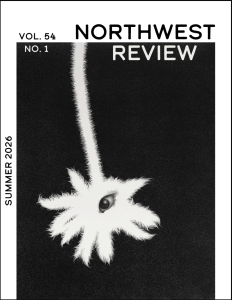 We’ve assembled an eclectic group of writers who take formal risks and often write with heart and humor. We have work from writers at all stages of their careers, from a short story by UO alum and Oprah Book Club pick Nathan Harris to Los Angeles musician Jess Cornelius’s first published story. We’re publishing “Unbound” by A. D. Nauman, which is a hilarious and moving story about a middle school girl possessed by a gay Quaker man-ghost. We have a unique flash piece by Ira Sukrungruang; a sharp lyric essay by Kristi D. Osorio on her grandmother’s murder and watching knife-centric horror films; an exploration of matrilineal inheritance, mental illness, and Harriet the Spy by emerging writer Sarah Barrett Olson; and a translation of a poem by seventeenth-century Persian-speaking Sufi poet Bedil Dehlavī. We’re publishing emerging and established poets from the Northwest and beyond, including Kieron Walquist, Leila Farjami, Allisa Cherry, and J. L. Chen. Lastly, the issue features stunning cover art from Portland-based Samantha Yun Wall.
Publication of the Northwest Review is supported by an undergraduate course at the University of Oregon. Can you tell us more about this program?
The NWR Publishing and Editing class gives advanced undergraduate students hands-on experience in the duties and skills of a professional literary editor. On Mondays, it’s a more typical classroom experience as we cover various topics about editing and publishing, but Wednesdays are “staff” days: in groups, students evaluate selections from the Submittable slush pile. They are accustomed to reading for lit classes and workshops, so it’s invaluable to have them read as editors—to read “living literature” and learn what distinguishes truly excellent work. They must come to a consensus about each piece and decide whether to pass it up or not. The term culminates in a “Pitch Day,” where, in larger groups, they decide on the two pieces they’ll officially pitch to the genre editors. One group pitched A. D. Nauman’s “Unbound” and were ecstatic that I ended up accepting it. At our launch party, one of the students read from Nauman’s story to a packed house.
The class gives undergrad students an exciting experiential learning opportunity in the humanities, which is rare. In addition to editing and proofreading skills, they learn how to work together on an editorial team, build consensus, argue for their particular aesthetic, and prepare work for publication. Their final projects are tailored to their individual skill sets and interests: video trailers, intensive copyediting, grant writing, public relations, social media campaigns, or book reviews. While they get this invaluable experience, we also have a large team of assistant and associate editors from the MFA program who read after the undergrads, so that every piece gets a more experienced consideration as well. Ultimately, the class embeds the magazine into the curriculum so that it has real value for the educational mission of the university.
What are your hopes and goals for the future of the Northwest Review?
We want to bring back the magazine in a sustainable way and continue the Northwest Review’s legacy of discovering emerging writers. We plan to publish two digital issues per year while offering reviews of and interviews with Pacific Northwest–based writers and former contributors on our blog year-round. We also want to create a yearly print anthology of our best work so readers can have the pleasure of a beautiful, printed artifact. We’d like to host literary events for the community. And we’d like to eventually establish a small press, publishing books of short stories, novels, creative nonfiction, and poetry. The Northwest needs a national magazine, a cultural hub for literature. We hope to be that hub. If people want to help us do that, they can donate here.
How can interested writers submit their work to the Northwest Review?
You can find us on Submittable. We are having a summer contest in poetry and CNF/fiction that opens June 15, with guest judges Michelle Peñaloza (poetry) and Mat Johnson (prose). Look out for our next submission window, which opens on September 1.