We spoke with Orion Magazine’s publisher, Neal Thompson, and editor in chief, Tajja Isen, in our latest Member Spotlight.
 What is the history behind Orion? When was it founded and what is its mission?
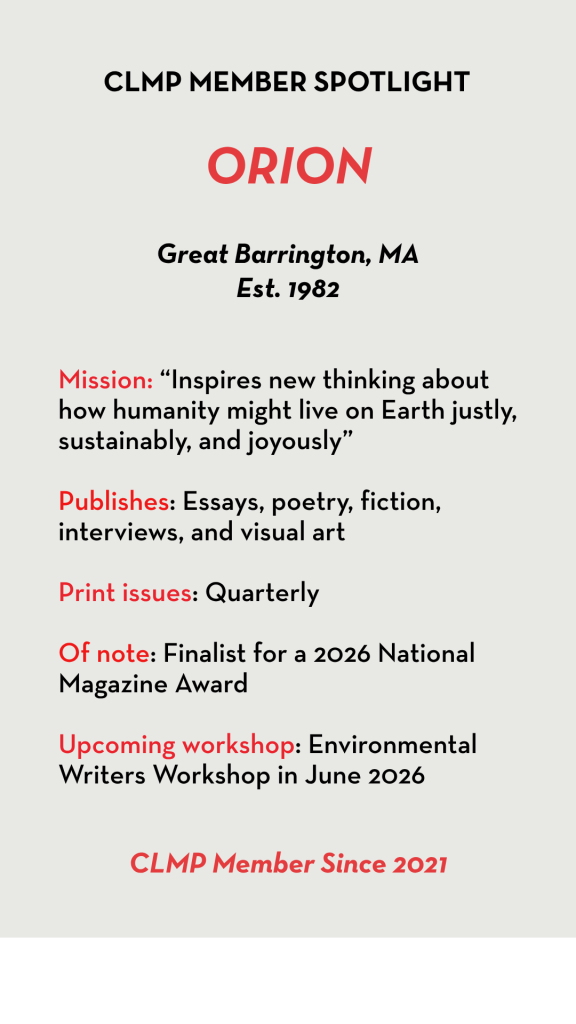
Orion was founded in 1982. We’re a nonprofit literary organization committed to cultivating a deeper sense of responsibility toward the planet and one another. We’ve been headquartered in Great Barrington, Massachusetts, since the 90s, but our staff is now remote and far-flung, with people in Portland, Las Vegas, Montana, Minneapolis, Massachusetts, and even Japan and Scotland. We’re working at the intersection of nature and culture, climate and community; our mission is to “invite readers into a community of caring for the planet” and, through writing and art, to “inspire new thinking about how humanity might live on Earth justly, sustainably, and joyously.”
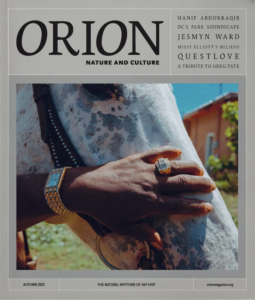
Named a 2026 National Magazine Award finalist, Orion publishes four print issues a year, plus essays, poetry, fiction, interviews, and visual art on our website. We have readers in every state and 225 countries, with an international print circulation of 15,000 and a digital reach of 1.5 million. We’ve published such luminaries as Jane Goodall, Barry Lopez, Robin Wall Kimmerer, Bill McKibben, and Maria Popova (all Orion advisors), Ross Gay, Aimee Nezhukumatathil, and Ocean Vuong. We host online and in-person classes, including our Environmental Writers Workshop each June. In recent years we’ve introduced new voices and ideas to our pages, expanding the scope and definition of nature writing, with a goal of nurturing the next generation of environmental storytellers. Our August 2025 issue, The Natural Rhythms of Hip-Hop, explored the complex relationship between place, music, culture, and race, and its guest editor Hanif Abdurraqib later called Orion “a place where writers can mine their curiosities—and offer new pathways into those curiosities for a reader.”
You launched a redesign with your Spring 2025 print issue—which also marked Orion’s 200th issue and has been selected as an ASME/National Magazine Awards 2026 finalist for their Single-Topic Issue category. Can you tell us about this redesign, and the Spring 2025 issue?
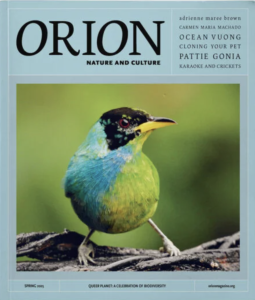 Our Spring 2025 redesign coincided with Orion’s 200th issue. The changes began with the cover—rather than a full-bleed image, our brilliant designer, Ella Frances Sanders, fashioned a lovely border around the cover image that makes it feel fresh and literary. As part of the redesign, we also debuted our new logo and an expanded table of contents that gives the reader a more spacious, meditative preview of the pieces that follow. We were thrilled to launch the redesign with that issue in particular, Queer Planet: A Celebration of Biodiversity, which honored the queerness abundant in the natural world. Guest-edited by Orion contributing editor Lulu Miller, the issue includes contributions from adrienne maree brown, Sabrina Imbler (whose essay will be anthologized in The Best American Science and Nature Writing 2026), Carmen Maria Machado, Kristen Arnett, Donika Kelly, Joseph Osmundson, and Ocean Vuong—a truly stellar lineup. We were thrilled to learn the issue had received a National Magazine Award nomination.
What can readers look forward to in your most recent or upcoming issue(s)?
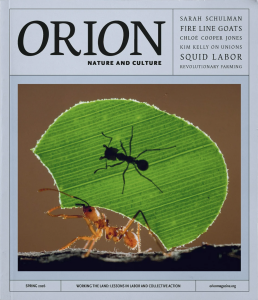 Our most recent issue at the time of this writing is the Spring 2026 issue, Working the Land: Lessons in Labor and Collective Action. The issue explores the intersection of labor and the environment, delving into the need for solidarity at a time when that value is frequently under attack. It includes contributors like acclaimed labor journalist Kim Kelly, legendary writer and activist Sarah Schulman, and food reporter Alex C. Park, and debuts a new travel column by two-time Pulitzer finalist Chloé Cooper Jones. The editorial team is currently in production on our summer issue, The Deep Dive, which is a love letter to whales and other cetaceans, and includes contributions from Alexis Pauline Gumbs, Vauhini Vara, and Chanda Prescod-Weinstein. For this issue, we wanted to put together a slightly expanded edition so that our audience can enjoy a little extra summer reading material—“a whale of an issue,” we’re calling it. (Sorry.)
Can you tell us about the Orion Questionnaire? What are some recent installments in the series?
The Orion Questionnaire offers our readers a way to get to know our contributors—among them some of the biggest names in environmental and literary writing—by learning a little more about their relationship with the natural world, and about things that their work might not immediately reveal or have reason to touch on. The tagline for the questionnaire highlights both “the sacred and mundane,” which is our way of encompassing lighthearted questions like: What is your most treasured comfort meal? And My favorite tree in the world is … We are lucky to have garnered responses from some of our leading contemporary writers, including Sabrina Imbler, Ross Gay, Erica Berry, and Terry Tempest Williams.
What is the Orion Environmental Writers’ Workshop?
The Orion Environmental Writers’ Workshop is a five-day, all-inclusive gathering designed to foster community, improve your craft, spark creativity, and renew or deepen your relationship with nature and place. Cosponsored by the Omega Institute in Rhinebeck, New York, this special week features small-group workshops, faculty readings, time with Orion’s editors, panels on writing and publishing, and an inspiring and restorative space to reinvest in your creative pursuits. Our 2026 workship will take place from June 14 to 19; faculty includes Erica Berry, Michael Kleber-Diggs, Roger Reeves, Isle McElroy, Maria Pinto, Hannah Dela Cruz Abrams, and Nicholas Triolo. For more information on how to apply, please visit our website or email us. The deadline for applications is May 1, 2026.
Are there any indie bookstores (or libraries) that you think do a particularly good job featuring print literary magazines, as well as titles from indie publishers? If so, what do they do?
Our staff includes former newspaper reporters, magazine writers and editors, and authors, all of us big fans of newsstands, libraries, and indie bookstores. They’re such great places to flip through a small press or ‘zine to discover new (or new-to-us) voices. A few indie favorites include Elliott Bay Books and Third Place Books in Seattle—they do a great job featuring lit mags and books from small presses. Orion sells a fair amount of copies at Barnes & Noble, so kudos to them for keeping newsstands in many of their stores. Other magazine- and/or small press–friendly bookshops that are local to some of our staff and deserve shoutouts: Powell’s Books in Portland; The Writer’s Block in Las Vegas; Fact & Fiction in Missoula, Montana; Square Books in Oxford, Mississippi; The Strand and McNally Jackson in New York City; and Rough Draft in Kingston, New York.
How can bookstores or libraries, as well as individual readers, order or subscribe to Orion?
 Call us or email us! A company called Disticor helps us distribute our magazine to indie bookstores and other newsstand retailers, including Barnes & Noble and Whole Foods stores; we work with EBSCO and OpinionArchives to distribute (digitally) to scores of libraries and universities. Individual readers can subscribe—in print, digital, or both—here, or give a gift subscription to a loved one here. We also have a special rate for students and educators. You can find and purchase back issues here. We also work with small retailers—food coops, gift shops, indie bookstores—to provide small numbers of current and back issues for resale. And thanks to a grant from Bloomberg Philanthropies, we’ve been digitizing our entire forty-four-year archives, which will be open to public access later this year.
How can interested writers submit their work to Orion?
Since our print issues are keyed to particular themes, our pitch calls are pretty specific. Four times a year, we craft an open submissions call on a given topic (always posted on our submissions page) and invite story pitches through Submittable. From that call, we accept a number of pieces—usually one or two features, several pieces for Lay of the Land (our front-of-book section), and a number for online exclusives. In addition to the strong network of writers that Orion is already lucky to consider a part of our community, we are excited about and committed to discovering new voices and welcoming them to our pages.
Finally, if you’d like to follow along with our work and get notified about upcoming workshops and events, sign up for our weekly newsletter and/or follow us on social media.