We spoke with Timothy Schaffert, the Glenna Luschei Editor in Chief of Prairie Schooner, in our latest member spotlight.
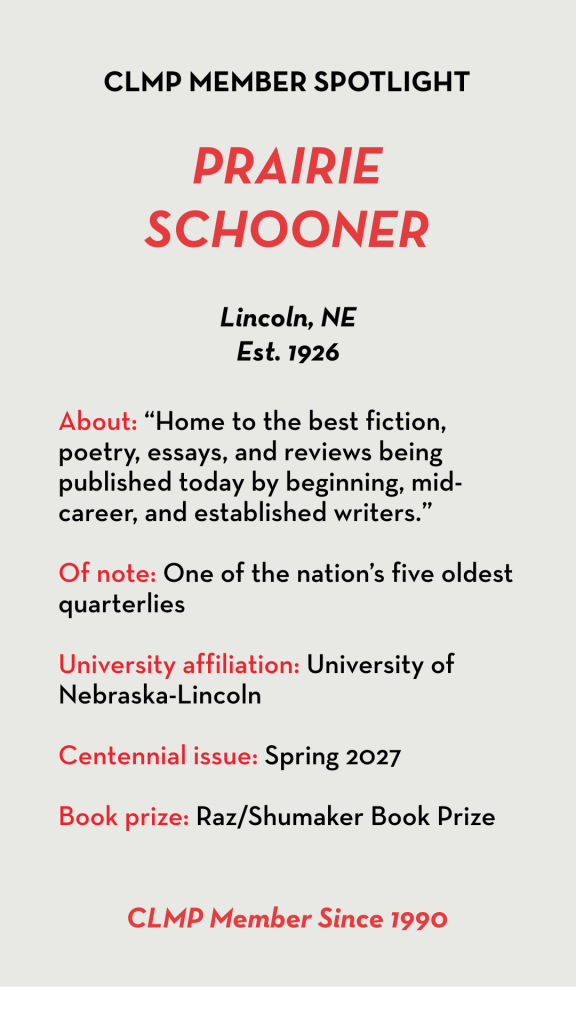 What is the history behind Prairie Schooner? When was it founded and what is its mission?
One of Prairie Schooner’s earliest stated missions was: “The work of unsworn and unaddicted writers is worth printing.” Lowry Wimberly, the journal’s first editor in chief, went on to say that “there is an honesty or frankness about the work of the non-professional writer.” Wimberly, along with some of his fellow editors, would in the 1930s become part of the Federal Writers’ Project, a New Deal program designed to provide jobs for these non-professionals. But the journal started with a literary society of college students who would have grown up during World War I, and their initial mission was very localized: publish themselves and the work of the Bohemians about town in Lincoln, Nebraska. They intended to publish the first issue of Prairie Schooner in 1926, but they didn’t have money for the printer, so they published in 1927. Paying bills was an issue that would nag at the journal for decades to come: the Depression, World War II, university budget cuts. But the quarterly almost immediately expanded its reach, especially when it got the attention of Edward J. O’Brien, an editor who celebrated literary publishing and whose annual yearbook eventually became the Best American series still published today; O’Brien’s blessing led to Prairie Schooner getting submissions from across the country within its first year of publication. And more recently: In 2025, Prairie Schooner published authors from six continents.
Prairie Schooner publishes its hundredth volume in 2026 and 2027! What can readers look forward to?
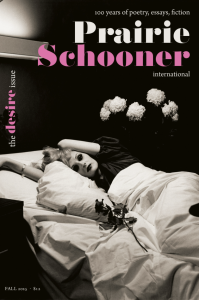 “The Loneliness Issue” comes out in March; it’s issue no. 1 of volume 100. (It gets a little confusing in the world of the literary quarterly; we’re publishing volume 100, because we’re in our hundredth year of continuous publishing, but our 100th anniversary won’t be until 2027.) Our recent themes—loneliness, desire (the fall 2025 issue), the body (which is our Summer 2026 theme)—have come together organically, from the writers themselves, and their shared ideas, expressions, and preoccupations.
We have some great portfolios ahead: Joy Castro is guest-editing Latinx flash memoir, and Hope Wabuke has a portfolio on Black nature writing. And we have a few side projects we’ll unveil around the centennial.
Tell us more about Prairie Schooner’s centennial. How will you be honoring the occasion, and what are your hopes and goals for the magazine’s future?
 We had a call for submissions for the Spring 2027 centennial issue, on the theme of “Awakening,” and we reached our cap; we’ve only just begun to read, but I suspect we’ll see the current state of things in high relief, that we’ll see work effervescent with joy, love, and compassion, and also heartbreak, despair, shock. We’ll see portraits of rescue and resistance.
I imagine, as we lean into the next hundred years, we’ll have writers and readers of literature rejecting the digital age; we’ll benefit from the pleasures people are taking by locking their phones up, closing their laptops, writing on typewriters, reading books and magazines in print. At a recent talk on campus, attended by about forty students, the speaker asked who among them use AI every day, and no one raised their hand. Maybe they were all being honest, or maybe some were just embarrassed to admit it, but I think it’s telling either way.
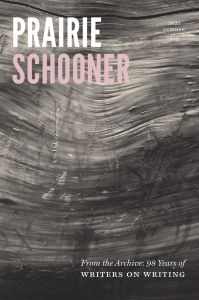
But we’re also doing some rescue work of our own, rigorously combing through the archive. We’ve published a vast number of notable authors over the years—multiple Pulitzer and Nobel winners, some of the earliest work of Eudora Welty, Cynthia Ozick, Joyce Carol Oates, Toni Cade Bambara, Joy Williams, Octavio Paz’s first publication in English—but the archive is remarkable for its documentation of the literary career in the modern age of literature… those “unsworn and unaddicted writers.” I’ll stumble across a terrific poem, by a poet I’ve never heard of, and an internet search will lead me to a fascinating portrait of the writer’s own life, and the particulars of expression, often during a time of great upheaval, and of rejection, by mainstream culture, of the obscure and arcane literary work we pursue.
What is the Prairie Schooner Raz/Shumaker Book Prize Series?
 In partnership with the University of Nebraska Press, we have a call for submissions (which closes March 15) for collections of poetry and short fiction. We publish one book in each genre every year, and many have gone on to great recognition; our most recent poetry publication, Death Does Not End at the Sea by Gbenga Adesina, was longlisted for the National Book Award and for the PEN/Voelcker Award. The prize is named for two beloved poets and arts philanthropists, Peggy Shumaker and Hilda Raz, the latter of whom served as the editor in chief of Prairie Schooner for over two decades, and whose leadership and management helped the journal become more financially independent.
Are there any indie bookstores or libraries that you think do a particularly good job featuring print literary magazines? If so, what do they do?
I’m partial to the library that’s right next door to the Prairie Schooner offices, Love Library of the University of Nebraska-Lincoln. Though I’ve only been the editor in chief since June, I’ve been teaching at the university for twenty years, and I was a student here in the late 1980s, and the library is how I first learned about literary journals and the kind of work they published. They had them all beautifully lined up in the periodicals section, and I would just sit there and read every chance I got. So that’s among our goals with the centennial: to get the journal in more libraries.
How can bookstores or libraries, as well as individual readers, order or subscribe to Prairie Schooner?
Readers can subscribe via our website, and libraries can email us.
How can interested writers submit their work to Prairie Schooner?
Subscribe to our newsletter, which you can do on the front page of our website, and you’ll be updated on calls for submissions. You’ll also see updates on our Instagram feed.