We spoke with Simmons Buntin, editor-in-chief of Terrain.org, in our latest Member Spotlight.
 What is the history behind Terrain.org? When was it founded and what is its mission?
Terrain.org was founded in 1997 and first published in 1998. Our goal was to bring together literary work, including poetry, creative nonfiction, and fiction, with more technical work, such as articles and community case studies. That technical work was essential because founders Simmons Buntin (me!) and Todd Ziebarth had both recently graduated with master’s degrees in urban and regional planning. There wasn’t a magazine then publishing that brought planning and architecture together with literature, whether online or in print, and we subtitled ours “A Journal of the Built & Natural Environments.” Our goal was to create a discourse about place that wasn’t limited to just literature or just articles and case studies. Since that time—and particularly since a) the 2016 presidential election and the launch of our Letter to America series and b) the summer of 2020 and the Black Lives Matter movement, we’ve become more activism-focused in the work we’ve published, dropping our original subtitle for a new, broader, more urgent mantra: “Place, Climate, Justice.”
Terrain.org was one of the first online literary journals. How has this early adoption of the digital space impacted your editorial vision?
We’ve been told that we’re the second-oldest online literary journal still publishing, just behind Brevity and just in front of DIAGRAM. That’s pretty cool—as is the fact that we’re the world’s first online literary journal of place. In those old days, it was often a challenge to get a writer’s top work because there was a stigma about online publications being of lesser quality. I admit there’s nothing quite like holding a well-designed print journal. But that stigma has gone away, both as traditional print journals have moved online—I think here of the renowned literary journal Shenandoah transitioning to fully online in 2011, for instance—and as our own lives have moved online with social media and apps. Even in those early days, however, we’d receive feedback from contributors who were enthusiastic about the exposure they received because their contribution was easy to find and share online. We archive our contributions indefinitely, and many of those early articles and essays, poems and stories, interviews and case studies are still referenced today, years and decades after publication.
Being an online journal has also impacted our editorial vision because we’ve strived to take advantage of the online medium itself. We’ve long included audio with poetry and short prose pieces, as well as image galleries, interactive maps, the occasional video, and other interactive features. I’d love to do more there—I think of the beautiful, engaging multimedia pieces in Emergence, Aeon, and the New York Times, for instance—but capacity constrains us, as we’re entirely volunteer-run and don’t have all the resources we’d like to really set us apart in this area.
Can you tell us about Terrain.org’s podcast?
 I’m delighted to report that we just relaunched our podcast series, which was previously titled Soundscapes and is now the more direct Terrain.org Podcast. Under the leadership of Tamara Dean, our new podcast editor, we’re aiming for quarterly episodes. Our first one, “The Gift of Animals,” is a conversation between Tamara and Alison Hawthorne Deming, editor of the gorgeous new anthology The Gift of Animals: Poems of Love, Loss, and Connection, as well as anthology contributors Nickole Brown, Jose Hernandez Diaz, and Camille Dungy.
Past episodes of our podcast remain on our site, and I’m grateful to our inaugural podcast editor Miranda Perrone for taking on the new-to-her-and-new-to-us task of creating a podcast so lovingly. And I’m grateful to Tamara for reimagining, editing, and producing the renewed series.
Terrain.org offers class exercises meant to help teachers incorporate the publication’s poetry, journalism, and community case studies into the classroom. Why is it important to introduce place-based literature to high school and college students?
 One answer is love. Which is to say, we care about and protect the things we love, and if we know our places—and the diverse places, cultures, and peoples of neighborhood and region, not to mention the world—more intimately, then we can care for them, love them, protect them. So one thing Terrain.org does is bring an intimacy to place (and climate and justice) no matter the reader’s age.
To answer the question more specifically, though, it’s important to introduce place-based literature to high school and college students because it cultivates empathy, sharpens critical thinking, and deepens a student’s understanding of how geography, culture, and identity intertwine in literature and in life. And doesn’t it sure seem like the world—and America in particular—needs a lot more empathy, critical thinking, and understanding these days?
What are some other literary journals, small presses, and organizations you admire that also publish environmental literature?
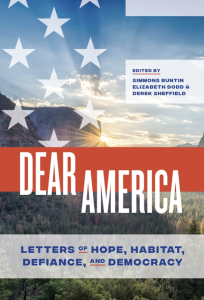 Terrain.org has long admired—and in many ways, based our design and literary scope on—Orion magazine, where beauty and quality of content are central, as is an ad-free environment. (Terrain.org has always been ad-free and free to access, and always will be.) I also admire Emergence in both print and online, Ecotone, The Common, Guernica, Camas, Aeon, The Hopper, Flyway, ISLE, Places, and undoubtedly several other important magazines and journals I’m forgetting. From a small-press perspective, there are so many important publishers, including Trinity University Press, which published Dear America: Letters of Hope, Habitat, Defiance, and Democracy in 2020 in concert with Terrain.org (and now needs your letters to their provost to prevent the journal’s sunsetting in just over a year, alas); Milkweed Editions; my two favorite House presses (Torrey House and Autumn House); a whole ecosystem of other university presses renowned for their place-based books (Oregon State, Utah, Nevada, California, New Mexico, Nebraska, Georgia, Columbus State, and Arizona, to name just the few I’m most familiar with); and Island Press, Ashland Creek Press, and Princeton Architectural Press (which is not associated with Princeton University). Let’s also throw the newspaper High Country News in this mix.
How can interested writers and translators submit their work to Terrain.org?
Our submission guidelines are on our website, and we use Submittable. We welcome new and established writers alike, though because of our current backlog, we won’t be reviewing poetry in 2026 other than our summer contest. We will be reading fiction and nonfiction from January 1 to April 30 per usual, however, and we accept Letter to America submissions year-round. Writers should also keep an eye out for calls for short-run series, too, such as our Lookout: Writing and Art About Wildfire series with Spring Creek Project a few years back.