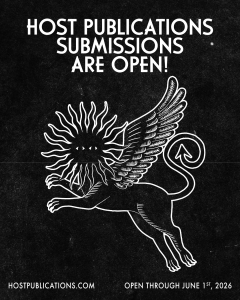
We spoke with Claire Bowman, editor in chief and co-executive director at Host Publications, winner of the 2026 Constellation Award, about the press’s editorial process. Host is accepting submissions of poetry collections through June 1.
 Host has curated such a wonderful collection of poetry books. What do you look for when combing through submissions?
Our poets are all so different, and yet their writing is in conversation in many ways. One thread we have identified in what we love to publish is an intensity of feeling, the visceral impact of language that offers so much more than narrative sense. We’re looking for writing that punches up, that can be vulnerable, devout, irreverent. In other words, we love poetry that makes meaning in ways that are disruptive and radical. Poetry that surprises us, that disorders our innate ways of thinking and perceiving the world.
At the same time, we’re looking for writing that is aware of its lineage, and in conversation with other writers, artists, and art forms that inspired it. That’s a way mutuality comes through in the writing of great poets, who are true to their voice, but recognize that they are speaking alongside so many others, including those who have
come before.
Host’s mission is to elevate systemically marginalized writers whose work is radical, experimental, and queer—an intersection you refer to as a poetics of liberation. Can you share more about that intersection and what it means to you all?
Poetics of Liberation is not a framework of our own invention, but one that has a history—in the Black Radical Tradition, queer liberation, trans liberation and other literary and political movements that inform our own values as a press, and continue to inspire us. Beyond just the aesthetic electricity of poetry’s lyrical mode, we’re drawn to the political urgency in the work of poets whose work enacts disruption—upending patterns of rational thought that are so often rooted in the puritanical ideals of settler colonialism. There are so, so many luminous ways that poets do this. Each new writer we work with teaches us something new in what is possible in poetry, and in our ways of thinking and being, which feels so critical in this historical moment.
The Poetics of Liberation that we value most is one that is invested in mutuality and restoration as modes of resistance. Focusing not only on the gross injustices of the system within which we exist, but, through experimentation, fragmentation, and imagining, creating ruptures through which we can be liberated from it.
What is Host’s editorial process like?
The writers we prioritize publishing include BIPOC, LGBTQ+, writers of a lower socio-economic status, and immigrant writers and writers with disabilities, and we are committed to holding space for all of the ways in which these marginalized identities intersect, mindful of each author’s specific needs in the editorial process. With this commitment in mind, we’ve carefully developed a highly collaborative editorial process that prioritizes the author’s vision for their book.
We begin with an author questionnaire, which is very thorough! From this form, we gain a better understanding of an author’s inspirations, editorial goals, how they came to write the book, and much more. The answers inform much of our discussions moving forward.
Typically, our editors meet with an author four to five times over the course of three months, to discuss editorial notes and edits that have been made to the manuscript, and to check in to make sure we’re all feeling good about the direction in which we’re moving. These discussions are often fun and exciting as we work toward making the best version of the book we possibly can, but there are also many tender moments, and we move with sensitivity around difficult topics, and all the emotions that go into putting a collection of poetry into the world.
Host publishes so many incredible writers, including Summer Farah, Chiagoziem Jideofor, heidi andrea restrepo rhodes, and others. Once you’ve begun working with an author, what does that relationship look like and how does it develop over the course of a project?
How is it possible that we come to love each and every author we get to work with? Though the range of personalities is vast, it never fails that after our first few meetings, there is a wonderful bond that forms in our collaboration on their book. We are the guides who walk through the tunnel with them, bringing what was once a mostly private relationship to their writing into the open, where it takes on a life of its own. That often brings up unexpected emotions!
These relationships are based on mutual trust and respect, so we lead with that in mind. Over the course of our time working together, we develop a shared language to speak about and understand their collection, and there’s something so intimate about that. But truly, we have been so lucky to have the privilege of knowing and working with each of our writers, who are just the best.
Besides reading your recent publications (available for purchase on the Host website or via your distributor), where else can writers learn about Host and hear more about your work?
Short answer: The Host Dispatch! That’s our literary podcast, where we interview our authors and talk about the (often queer, feminist) books, small presses and community leaders who are inspiring us right now. Sometimes, we get really silly on there, but even in an episode like “What the Hell is a Linebreak?” in which we question everything we thought we knew about poetic form, you’ll encounter the strange ways our little brains operate. Other great episodes to learn more about what we do at Host are “Let’s Talk About Submissions,” “Celebrating Queer Poets” and “Adventures in Book Design: Color.” We also have a lot of fun on social media, so if you’re online, pop by and say hello!
Is there anything else you’d like to share with the CLMP community?
POETRY IS ALIVE!
— interview by Kathy Serna, CLMP spring 2026 intern